










……Tinubu’s Reforms Inspired the Publications – Vambe
By Aderonke Ojo
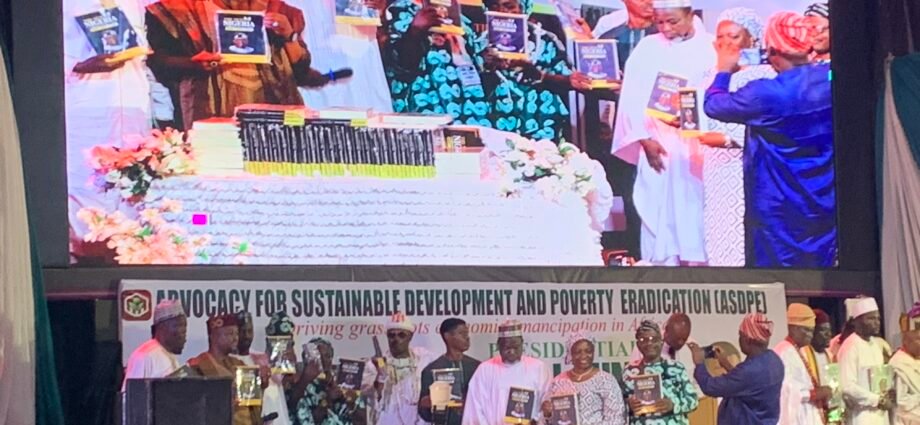
The President and Founder of Advocacy for Sustainable Development and Poverty Eradication (ASDPE), Bishop Dr. Joseph Aunde Vambe, has unveiled two books examining the economic reforms, governance policies and security challenges of President Bola Ahmed Tinubu’s administration, with a call for greater grassroots participation in national development.
The books, titled The New Nigeria: Compliments to the Game Changer, Volume One – Nigeria Economy and Volume Two – Nigeria Insecurity, were presented at a public book launch and empowerment initiative themed “The New Nigeria: Compliments to the Game Changer.”
The event, held at the Nigeria Merit Award House, Maitama, Abuja, on Thursday, brought together government representatives, religious leaders, academics, development advocates, security experts, political stakeholders and members of civil society.
The publications, authored by Bishop Dr. Vambe, seek to document and examine the policies, reforms and governance initiatives of President Tinubu under the Renewed Hope Agenda, particularly their implications for economic recovery, poverty reduction, national security and inclusive development.
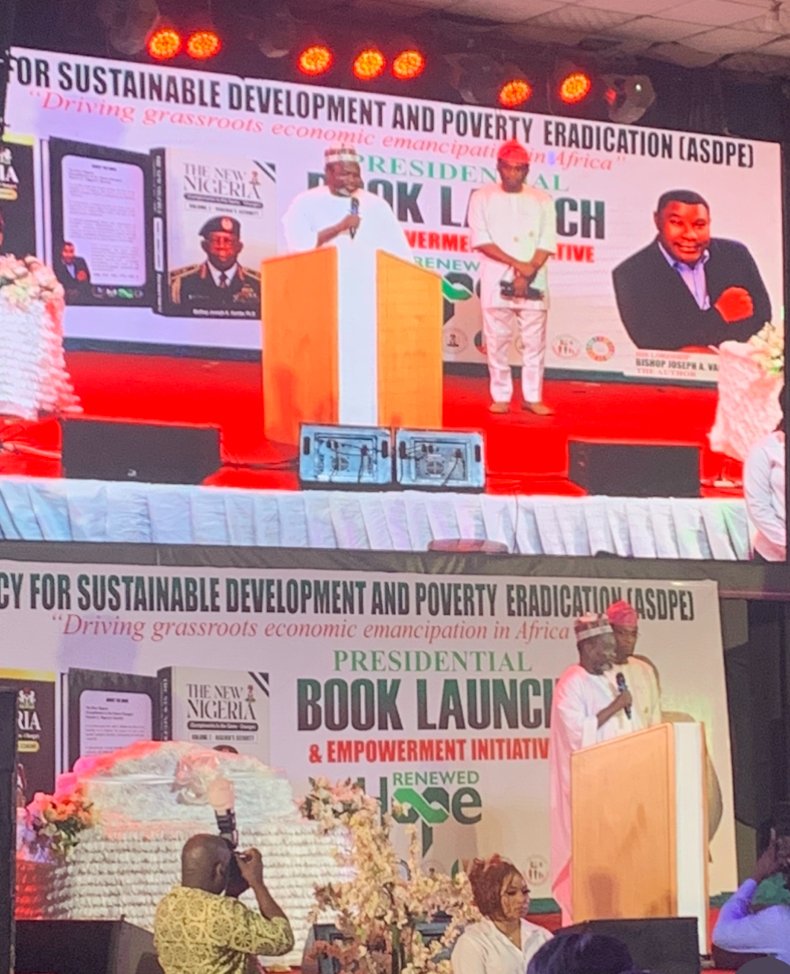 Speaking during an personally interview at the event, Bishop Vambe said President Tinubu’s leadership and policy decisions, particularly the removal of the fuel subsidy, inspired him to undertake the extensive research that eventually resulted in the two volumes.
According to him, he initially intended to write an article examining the administration’s policies following the removal of the fuel subsidy in May 2023.
However, as he continued researching and documenting developments, the material became too extensive for a single article.
He explained that his interest subsequently expanded to cover the administration’s economic, social and structural policies, eventually culminating in the two publications.
“Honestly, I must be frank that the transformative leadership of President Bola Ahmed Tinubu, GCFR, is what inspired me.
“ From the day he removed the fuel subsidy, I started writing an article which I intended to send to my Chief Press Secretary for publication in the media. However, I discovered that what I was writing had become voluminous.
“That was how I began following the administration’s policies, including its economic, social and structural reforms, until the research developed into these two volumes we are launching today,” he said.
The  author emphasised that national development must not be concentrated in urban centres, stressing that Nigerians have a collective responsibility to return to their communities and contribute to the development of rural areas.
He said that every Nigerian originated from a local community and should therefore support initiatives that improve economic opportunities, infrastructure and livelihoods at the grassroots.
“We are all grassroots people. We came from somewhere, and we must not abandon our rural communities simply because we have moved to urban centres.
“ We must go back and contribute to the development of the places we come from.
“Grassroots economic emancipation is our responsibility. We must support initiatives that promote sustainable development, eradicate poverty and create opportunities for people at the community level,” he said.
Addressing the challenges and opportunities facing young Nigerians, the ASDPE president urged youths to embrace initiatives under the Renewed Hope Agenda, which he described as a framework for restoring confidence in the country’s future.
He specifically identified the Nigerian Education Loan Fund (NELFUND) as an important intervention capable of improving access to higher education.
 According to him, the student loan initiative represents a significant development in Nigeria’s educational financing system, providing financial assistance to students who might otherwise struggle to meet their educational expenses.
He cited the reported figure of more than 1.6 million beneficiaries as evidence of the programme’s reach and urged young Nigerians to take advantage of opportunities created through government interventions.
Vambe encouraged citizens to support policies that promote education, economic inclusion and sustainable development while remaining actively involved in nation-building.
In his welcome remarks, Bishop Vambe expressed appreciation to everyone who contributed to the successful publication and presentation of the two books.
He described the project as a demanding intellectual undertaking that required considerable time, commitment and personal sacrifice.
The author disclosed that he had more than 18 additional manuscripts yet to be published, expressing optimism that the successful launch would encourage him to make more literary contributions available to Nigerians.
He also acknowledged the sacrifices made by his wife and children during the writing process, noting that their patience and understanding helped him complete the project.
 Vambe further appreciated Dr. Emmanuel Afolabi, Ambassador Kate Okwaneke, members of the Central Working Committee, particularly its chairman, Honourable Shehu Manson, and other members of ASDPE for their support.
He reiterated his organisation’s commitment to promoting grassroots economic development, poverty eradication, good governance and sustainable development across Nigeria and Africa.
Bishop Dr. Joseph Aunde Vambe is a philanthropist with a strong commitment to grassroots economic emancipation in Africa.
He is the President and Founder of Advocacy for Sustainable Development and Poverty Eradication (ASDPE), as well as the Presiding Bishop and Chairman of the Board of Trustees of the International Christian Organization for Sustainable Development (ICOSD).
Both organisations are non-governmental organisations with membership across Nigeria’s 36 states, the Federal Capital Territory and the diaspora.
Their activities focus on promoting good governance, poverty eradication, sustainable development and economic empowerment, particularly among underserved communities.
Vambe also serves as a Board Member representing the North-Central geopolitical zone at the Office of the National Grassroots Mobilisation for President Bola Ahmed Tinubu, GCFR, 2027.
According to the author, the two books were deliberately written to address misconceptions surrounding the Tinubu administration’s policies and reforms by presenting information, facts and figures that would enable Nigerians and the international community to understand the country’s evolving political economy under the Renewed Hope Agenda.
Jigawa Governor’s Representative Commends Documentation of National Development
The Governor of Jigawa State, Malam Umar Namadi, who chaired the occasion, was represented at the event.
In his address, the representative commended Bishop Vambe and the organisers for undertaking what he described as an important initiative aimed at documenting government policies, leadership decisions and national development experiences.
He said the presentation of the two volumes provided an opportunity for Nigerians to reflect on the country’s development journey, ongoing reforms and the collective responsibility of building a peaceful, prosperous and inclusive nation.
He stressed that documenting national experiences was essential because it created opportunities for citizens, researchers, policymakers and future generations to learn from achievements, understand challenges and develop better solutions.
“A country that documents its experiences creates opportunities for citizens, researchers, policymakers and future generations to learn from its successes, understand its challenges and contribute to better solutions,” he said.
He further observed that the value of knowledge should not be measured solely by what individuals know but by how effectively they apply it to improve human lives.
Speaking on the development priorities of Jigawa State, he explained that the government was committed to creating an enabling environment where citizens could develop their abilities, establish businesses, access opportunities and become economically independent.
He also highlighted the importance of social protection programmes in supporting vulnerable households, strengthening economic resilience and creating safer communities.
He called for stronger partnerships among government institutions, development organisations and other stakeholders to advance education, economic empowerment, good governance, national unity and sustainable development.
The Chairman of the Sub-Committee of the various organising committees, His Lordship, Bishop Dr. Emmanuel Afolabi, expressed gratitude to God for the successful completion of the project.
He disclosed that preparations for the book launch had commenced almost two years earlier, describing the successful conclusion of the initiative as a collective achievement.
Bishop Afolabi encouraged Nigerians, particularly leaders and professionals, to embrace the culture of writing and documenting their experiences.
He said that books preserve knowledge, ideas and personal contributions for future generations, adding that written works serve as enduring legacies long after their authors are gone.
He urged Nigerians to make writing and publishing a priority, stressing that documenting experiences would help younger generations understand the contributions of those who came before them.
Lanre Adebayo , Reviews Volume One, Highlights Economic Reforms,The New Nigeria: Nigeria Economy, Dr. Lanre Adebayo, Director-General of The Progressive Institute (TPI), described the publication as an important contribution to public discourse on leadership, economic reforms and national development.
He approached his review from the perspective of democratic governance, arguing that the performance of any administration must be assessed within the framework of the Constitution, the rule of law and the responsibilities of elected leaders.
Adebayo identified revenue generation as one of the fundamental responsibilities of government, explaining that without adequate resources, administrations would struggle to implement development programmes and fulfil their obligations to citizens.
He particularly examined the removal of the petroleum subsidy, describing the policy as an attempt to address what he characterised as a major financial drain on the country’s resources.
According to him, Nigeria’s petroleum subsidy regime had created significant financial pressures and encouraged the subsidisation of consumption beyond the country’s borders.
He argued that removing the subsidy had increased allocations available to the three tiers of government, providing federal, state and local governments with additional resources to pursue development programmes.
Adebayo observed that the increased allocations had created opportunities for state governments to embark on infrastructure projects and other development initiatives.
He also highlighted the need to translate increased government revenue into tangible improvements in the living conditions of ordinary Nigerians.
While acknowledging the importance of economic reforms, he emphasised that citizens must be actively involved in governance to ensure that the benefits of increased resources reach communities across the country.
He commended Bishop Vambe for documenting the reforms and contributing to national conversations about Nigeria’s economic future.
Adebayo further encouraged journalists, researchers and other professionals to undertake independent analysis of government policies to strengthen public understanding and promote informed national debates.
Reviewing the security-related issues addressed in Volume Two, the Minister of Defence, General Christopher Gwabin Musa (Rtd.), emphasised that national security was a collective responsibility requiring the participation of government institutions, security agencies and ordinary citizens.
He said that addressing Nigeria’s security challenges required more than government expenditure, stressing the importance of intelligence gathering, information sharing, effective coordination and cooperation among security agencies.
According to him, investments in personnel training, equipment and operational capacity must be sustained to enable security agencies to respond effectively to emerging threats.
He also stressed the need for citizens to cooperate with security agencies by providing credible and timely information that could help prevent security incidents before they escalate.
The minister called for stronger institutional coordination and improved leadership and management within the security architecture.
He further emphasised that resources allocated to security operations must be judiciously utilised to achieve the desired results.
General Musa also highlighted the importance of strengthening local government administration and community-based security structures.
He argued that local governments must become more functional and responsive to the needs of their communities, noting that effective grassroots governance would help rebuild public confidence and strengthen the relationship between citizens and security institutions.
He maintained that communities possess valuable knowledge about local security conditions and that this knowledge should be incorporated into broader national security strategies.
The minister also advocated stronger African representation in international decision-making institutions, particularly the United Nations Security Council, arguing that African countries should have a greater voice in determining solutions to security challenges affecting the continent.
He congratulated Bishop Vambe for documenting issues surrounding Nigeria’s security challenges and contributing to discussions on sustainable solutions.