











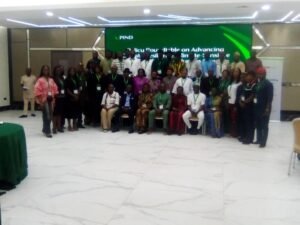
The need for climate-friendly peace-building efforts in the Niger Delta formed the basis of a stakeholder engagement meeting in Port Harcourt on Wednesday.
Tagged Policy Roundtable on Advancing Climate Resilience, Climate-Sensitive Peace-building and Human Security in the Niger Delta, the program, held under the auspices of Foundation for Partnership Initiatives in the Niger Delta (PIND), gave stakeholders the opportunity to deliberate on the impact of climate change and its trickle-down effects across communities in the Niger Delta.
According to the stakeholders, which constitute representatives of non governmental organizations, civil society organizations, government agencies, climate impacted communities, United Nations Development Program and the media, a lot of hazards like ocean surge, flooding, livelihood destruction, hunger, poverty and social vices such as migration, stealing, violence and other forms of insecurity witnessed in the Niger Delta are linked to climate change.
They therefore called for concerted efforts, institutionalized strategic measures, environment – friendly policies and transparent governance approach to mitigate the menace of climate change and its impact on Niger Delta riverine communities.
In his welcome remarks, Dr David Udofia, Peacebuilding Programme Manager, Foundation for Partnership Initiatives in the Niger Delta, lamented that climate change had become one of the defining geo-economic factors in the Niger Delta.
He said recurrent climate change-induced floods expose affected individuals to forced migration to safe, upland areas, survival of the fittest syndrome marked by stiff competition for available scarce resources in refuge areas, as well as frictions, quarrels and conflicts resulting from such competitions.
“Environmental degradation can destroy livelihoods. Climate change is no longer an environmental issue alone. It is also an economic issue; it is a governmental issue. Most importantly, it is a human security issue,” he said.
Udofia decried the non-inclusion of data and local intelligence strategy in climate change policy formation efforts by governments in the fight against the menace, noting that synergy with all stakeholders is very crucial for fruitful results to be achieved.
A university Don, Prof Olanrewaju Lawal, in his speech, advocated for a paradigm shift from reactive to proactive measures in dealing with climate and environment-related hazards in the Niger Delta Region.
He further recommended: “Make remediation risk-based and livelihood – linked. Assess contamination and livelihood assets, shifting from reactive relief to anticipatory, multi-sectoral action. Build an integrated regional architecture,” he advised.
Sharing his community’s experience, Ebijimi Olugbenga, from Bijimi, in Ilaje Local Government Area of Ondo State, said ocean surge and flooding caused by climate change had washed away some communities, inflicting pain on households and destroying livelihoods.
“Our livelihoods depend on the land and water, but flooding and environmental degradation are making it increasingly difficult for families to farm, fish and earn money,” he lamented.
Highlight of the roundtable a demonstration of PIND’s newly deployed Climate Data Filter on the Niger Delta Peace Map, which integrates climate-related information into conflict analysis and early-warning processes.
The tool is expected to help policymakers identify emerging risks, strengthen anticipatory action and make prompt, evidence-based decisions.