










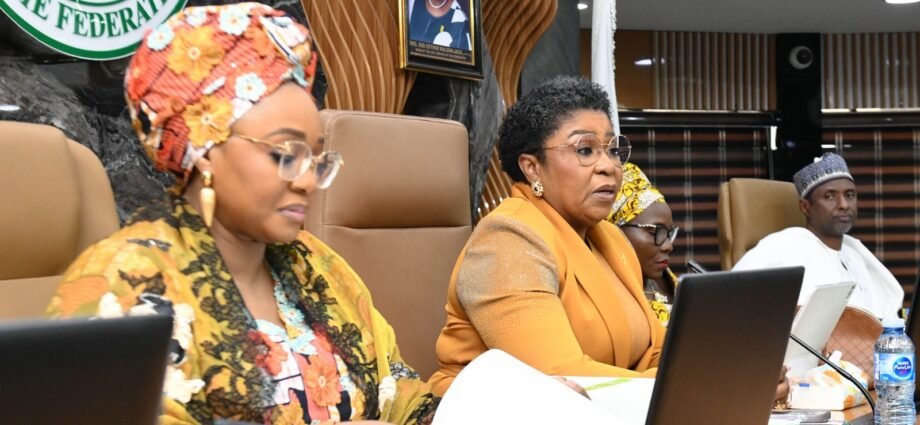
The Head of the Civil Service of the Federation (HCSF), Mrs Didi Walson-Jack, has urged Permanent Secretaries and other accounting officers to mainstream gender-responsive leadership and women’s economic empowerment into government policies, budgets and programmes.
Walson-Jack made the call at a workshop on Gender-Responsive Leadership and Women’s Economic Empowerment Policy for Permanent Secretaries, the Accountant-General of the Federation and the Auditor-General for the Federation in Abuja.
She said women’s economic empowerment should not be treated as a narrow women’s issue, but as a national productivity, governance and development imperative.
According to her, Nigeria cannot achieve its full potential while a significant proportion of its talent and enterprise remains constrained by barriers that public policies can remove.
The HCSF said the National Women’s Economic Empowerment Policy and Action Plan 2023-2028 provided a framework for addressing barriers confronting women in agriculture, entrepreneurship, the labour market, emerging industries, education and skills acquisition.
She said the policy was also supported by financial inclusion, digital access, supportive institutions and data-driven government processes.
Walson-Jack stressed that its implementation was the responsibility of all Ministries, Departments and Agencies (MDAs), and not the Federal Ministry of Women Affairs alone.
“My Transformative Permanent Secretaries, you are the custodians of institutional continuity, the bridge between policy and execution, and the leaders who convert government priorities into programmes, budgets and services,” she said.
She urged Ministries to identify actions under the policy’s costed implementation plan that fell within their mandates and assign clear responsibilities for their execution.
She said such actions should be reflected in sector plans, annual budgets, procurement decisions and programme designs.
The HCSF also called for the use of gender-disaggregated data to establish baselines, set realistic targets and track outcomes.
She urged government institutions to engage women who were expected to benefit from policies, stressing that policies designed without the input of beneficiaries might fail to provide appropriate solutions.
Walson-Jack further said gender-responsive leadership should begin within government institutions, adding that it was not about lowering standards or replacing merit.
“It is about ensuring that merit can emerge and thrive without unfair or avoidable barriers,” she said.
She identified access to training, strategic postings, mentoring, promotion, leadership assignments, flexible support systems and safe workplaces as areas that should receive attention.
The HCSF said the workshop was also an opportunity to connect the women’s economic empowerment agenda with the Federal Civil Service Strategy and Implementation Plan 2026-2030 (FCSSIP30).
She said gender-responsive leadership and women’s economic empowerment should be mainstreamed into workforce planning, capability development, digital transformation, service delivery, performance management and institutional accountability.
Walson-Jack said the Renewed Hope Agenda of President Bola Ahmed Tinubu placed inclusive growth, enterprise and improved livelihoods at the centre of national development.
She urged participants to use the workshop to identify institutional gaps, clarify responsibilities and agree on practical actions that could be monitored after the meeting.
Also speaking, the Minister of Women Affairs and Social Development, Hajiya Imaan Sulaiman-Ibrahim, said the workshop was significant because it brought together key accounting and auditing officers involved in the implementation chain of government policies.
She said the gathering brought together Accounting Officers of the Federal Government, the office responsible for maintaining the accounts of the Federation and the office responsible for auditing them.
“That combination is not ceremonial. It is the entire implementation chain, seated together for once,” she said.
Sulaiman-Ibrahim said gender-responsive leadership was about decisions taken in the ordinary course of government business, including which programmes were prioritised, funded, procured and monitored.
She said it also covered decisions on postings, promotions, nominations and leadership responsibilities.
The minister said the National Women’s Economic Empowerment Policy had five sectoral pillars — agriculture, entrepreneurship, the labour market, emerging industries, and education and skills — supported by four cross-cutting enablers.
She stressed that the policy was not the exclusive responsibility of the Ministry of Women Affairs, noting that several MDAs had responsibilities under its sectoral pillars.
Sulaiman-Ibrahim particularly highlighted gender-responsive and data-driven government processes as an area requiring the direct involvement of accounting officers.
“My Ministry cannot write another Ministry’s sector strategy. It cannot sign another Ministry’s budget submission. It cannot open an account code or determine the scope of an audit. Only the officers seated here can do those things,” she said.
The minister disclosed that the policy, launched in 2023, had been domesticated in Kaduna, Kano and Lagos states, while other states had expressed interest in the process.
She said the policy had also reached its midpoint review, adding that the review provided an opportunity to assess whether implementation was achieving the desired outcomes for Nigerian women.
Sulaiman-Ibrahim said the ministry was working through the Presidential High-Level Advisory Council on Support for Women and Girls to leverage private-sector and donor capital alongside government resources.
She urged Permanent Secretaries, as Accounting Officers, to implement the costed plan under the policy and ensure that capital lines in their budget submissions clearly identified their intended beneficiaries.
The minister said women remained constrained in key sectors of the economy, particularly agriculture and enterprise, due to unequal access to inputs, finance, land, extension services and other productive resources.
She cited joint analysis by the World Bank and UN Women, which she said estimated that Nigeria lost about N3.5 trillion annually to gender gaps in agriculture, rising to as much as N12.2 trillion when spillover effects were included.
Sulaiman-Ibrahim said addressing the gaps required expanding women’s access to finance, inputs and mechanisation, redesigning extension services, supporting women’s transition into higher-value economic activities and investing in girls’ education.
She also highlighted the Nigeria for Women Programme, saying it had improved livelihoods through the organisation of women into Women Affinity Groups and the provision of training, financial literacy and technical support.
The minister said President Tinubu had expanded the programme with a target of reaching 25 million beneficiaries nationwide.
She added that the Women’s Economic Empowerment Policy had been integrated into the Renewed Hope Social Impact Interventions across the 774 Local Government Areas.
Sulaiman-Ibrahim said the integration covered programmes including EmpowerHer, WAVE 774, PowerHer 774, HerSafeHaven, Families First and DigitHer.
She said the objective was to align existing programmes, capital and implementation pipelines to ensure that women’s economic empowerment translated from policy documents into measurable improvements in the lives of Nigerian women.
The minister assured that the Ministry of Women Affairs and Social Development would continue to track commitments, convene partners and strengthen coordination across federal and subnational levels.
She said women’s economic empowerment was central to Nigeria’s growth, productivity and long-term stability, adding that the success of the policy would ultimately be judged by its impact on the lives of Nigerian women.